Brazil's tax authority will calculate your tax. Who will explain your credit?
With CBS and IBS, the government starts assessing debits and credits for the company. The number will arrive ready-made. What doesn't come with it is the reason part of the credit is left out, and that is where margin starts to leak.
The Brazilian consumption tax reform (Constitutional Amendment 132/2023, regulated by Complementary Law 214/2025) replaces five taxes with a dual VAT: CBS (federal consumption tax) and IBS (state/municipal goods and services tax), plus the Selective Tax on specific products. The promise is simple: a truly non-cumulative tax, with broad credit on what the company buys.
In practice, "broad credit" does not mean "automatic credit". The right to credit starts to depend on things the tax team doesn't control alone: whether the supplier paid, how it is classified, whether the document matches the register and whether the ERP talks to the official assessment.
The calendar, in one table
The transition lasts seven years. At each stage something changes in pricing, cash flow or tax assessment.
| Year | What happens |
|---|---|
| 2026 | Test year: CBS of 0.9% and IBS of 0.1% shown on the tax document, offsettable against PIS and Cofins (the federal taxes being phased out). Systems and registers need to be ready. |
| 2027 | CBS at the full rate. PIS and Cofins cease to exist. The Selective Tax begins and IPI (federal excise tax) is zeroed (except for the Manaus Free Trade Zone). |
| 2029 to 2032 | ICMS and ISS (state and municipal taxes) fall gradually while IBS rises in the same proportion. The two systems coexist, and the company assesses both. |
| 2033 | Full regime: ICMS and ISS abolished, CBS and IBS alone. |
The five points where credit gets stuck
Looking closely at operations, the problems repeat. Almost none is about calculation. They are about registers, processes and negotiation.
1. The supplier
Credit depends on the tax having been paid in the previous stage. A supplier that is in default, has irregular documents or is under Simples Nacional (Brazil's simplified tax regime, which passes on credit limited to what was actually paid) reduces your credit, even if the invoice is correct. The question "how much credit does each supplier generate for me?" becomes part of the purchasing decision.
2. Reconciliation between ERP, accounting and the official assessment
The assisted assessment will show what Receita Federal (Brazil's federal tax authority) considers credit. The ERP will show what the company recorded. Accounting will show a third number. A difference that isn't explained becomes stuck credit or, worse, credit that expires.
3. Pricing
Tax will be calculated "on top" of the price. The price list that embedded PIS, Cofins, ICMS and ISS needs to be redone, and the margin of each product changes with each year of the transition. Those who pass it on wrongly lose sales or lose margin.
4. Renegotiating with suppliers
A supplier that looks cheaper today may turn out more expensive once credit is considered. Comparing proposals by net cost rather than face price becomes routine for purchasing.
5. Contracts
Long contracts, especially for services, were priced with the old tax burden. Without a tax rebalancing clause, someone will absorb the difference, and it is not always the other party.
What about split payment?
With split payment, the tax is separated at the moment of payment and goes straight to the tax authority. For sellers, the tax money no longer passes through cash. For buyers, credit becomes more traceable. For everyone, working capital changes, and this needs to be part of the cash flow projection.
The tax authority calculates. Easy IVA analyzes and guides.
Easy IVA was designed for the space the official assessment leaves open: explaining the number and saying what to do with it. Instead of recalculating the tax, it shows where credit is at risk and why.
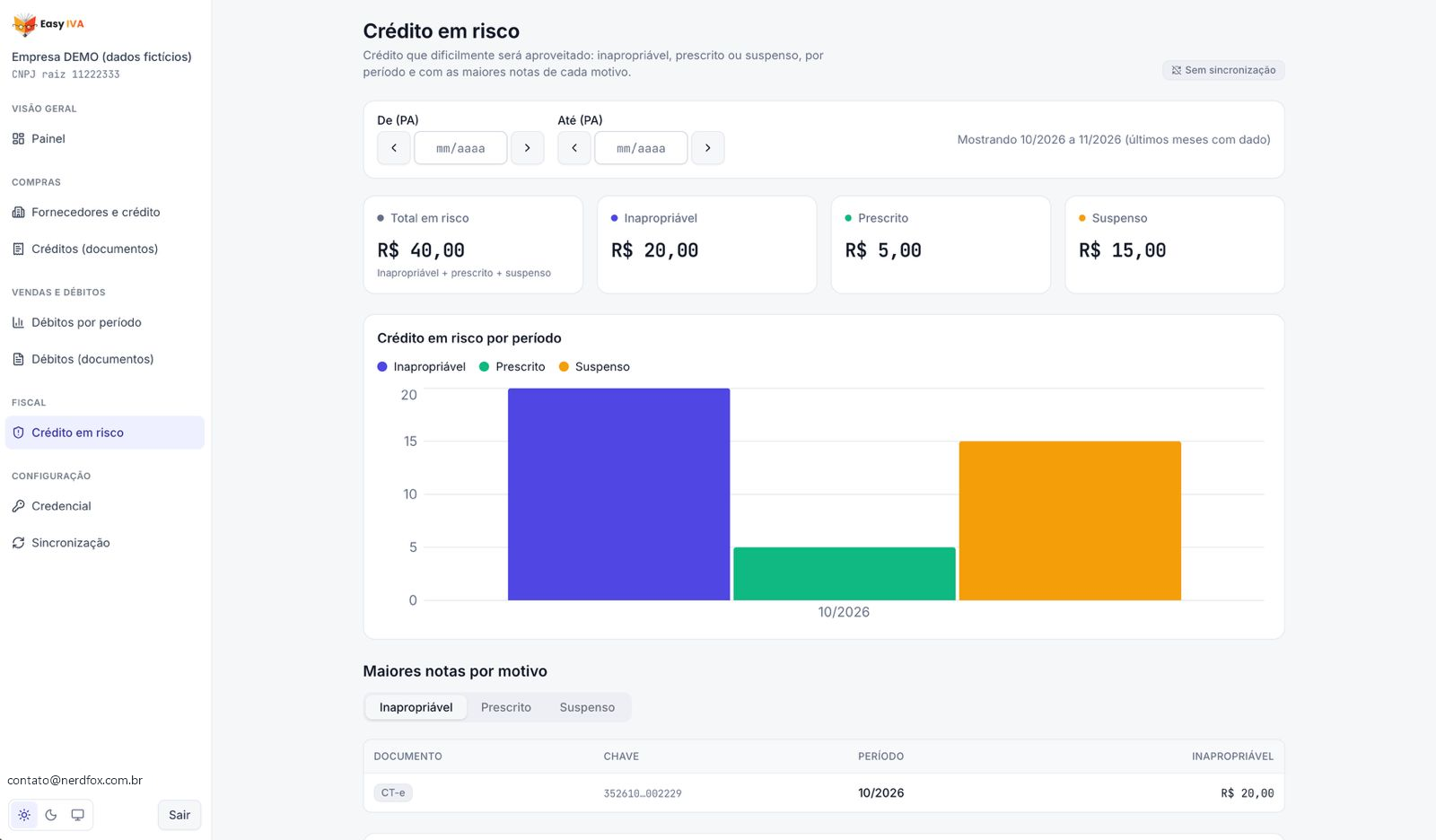
- Credit at risk: how much is unclaimable, expired or suspended, by period, and which invoices weigh most for each reason.
- Suppliers and credit: credit concentration among the largest suppliers and who has had credit pending for more than 60 days.
- Reconciliation: what is in the ERP and in accounting versus what the official assessment recognizes.
- Pricing and contracts: the effect of credit on margin and on the clauses that need to be reviewed.
Tax reform is not just a tax project. It affects pricing, margin, cash flow, purchasing, contracts and systems.
Checklist to get to 2027 in good shape
- Product and service registers reviewed for the new tax classification.
- ERP and invoice issuers issuing CBS and IBS correctly since the test year.
- Map of the suppliers that generate the most credit and of those under Simples Nacional.
- Price list simulated with tax "on top", year by year through 2033.
- Long contracts reviewed, with a tax rebalancing clause.
- Cash flow projection that takes split payment into account.
Free pre-assessment within 10 days
We look at tax, purchasing, pricing and contracts and show where the greatest credit risk lies in your operation.
Informational content, based on Constitutional Amendment 132/2023 and Complementary Law 214/2025. The regulation is still in progress and does not replace the analysis of the specific case.