Is the asset on the balance sheet really in your company?
In many companies, the accounting list of assets and what actually exists in the offices, warehouses and construction sites tell two different stories. A physical inventory is what puts the two back on the same page.
How the register drifts from reality
Nobody decides to have a wrong asset register. It becomes wrong little by little, with each movement that wasn't recorded:
- Informal transfers: the laptop changes departments, the equipment goes to another unit, the desk moves up two floors. The register keeps pointing to the old place.
- Write-offs that never happened: the asset was scrapped, sold or stolen, but it remains on the balance sheet and keeps depreciating.
- Lost or illegible asset tags: without identification, the asset exists physically but can't be linked to the accounting record.
- Acquisitions booked in bulk: an invoice for "50 chairs" becomes a single record, and nobody knows where each one is.
- Construction and improvements: the amount enters fixed assets without the breakdown into components that accounting needs.
What it costs
Depreciation of assets that no longer exist and assets with no record distort income and equity.
An auditor who can't verify fixed assets points out the weakness in the report.
Without knowing what exists and where, the company buys again what it already has sitting idle somewhere else.
A policy calculated on a wrong base and difficulty proving the asset when something happens.
What a well-run inventory looks like
An inventory is not going around counting chairs. It is a project with a beginning, middle and end, and the end is adjusted accounting.
- Planning
Accounting base for fixed assets, map of units, buildings, floors and rooms, identification rules and a schedule by area.
- Asset tagging
Each asset receives a unique, durable identification, linked to the record that will exist in the system.
- Field inspection
Each item is recorded with a photo, location, condition and identification data (brand, model, serial number).
- Reconciliation
What was found is cross-checked against the accounting base. Each item ends up as reconciled, physical surplus (it exists but is not in the register) or accounting surplus (it is in the register but was not found).
- Handling and adjustments
Surplus items are analyzed and become write-offs, additions or register corrections, with evidence for the audit.
Where Easy AUDIT comes in
Easy AUDIT is Nerdfox's system for field asset inventory and audit. The team inspects through the app, with search by tag number or description and code scanning, and each item reaches the dashboard with a photo, location and reconciliation status.
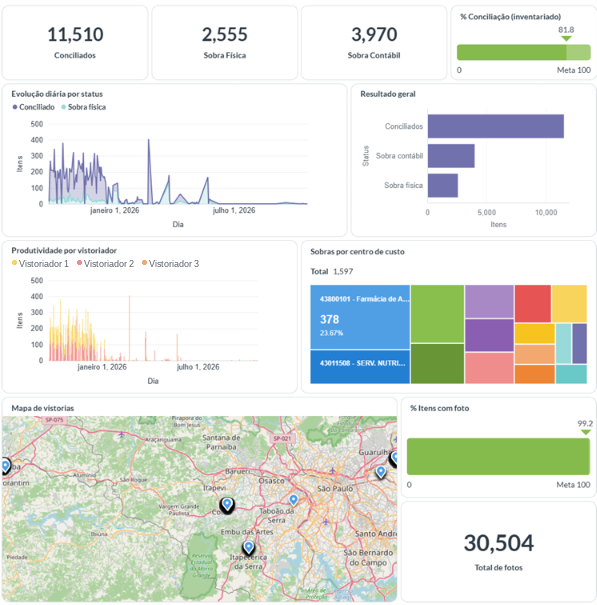
- Daily tracking: reconciliation percentage, physical and accounting surplus items and the progress of the work day by day.
- Team productivity: how much each inspector surveyed and where, on the inspection map.
- Asset record with evidence: location by cost center, building, floor, site and room, with the photo taken in the field.
- Continuity in Easy A7: the inventory result flows into Easy A7, where surplus items are handled together with the accounting register of fixed assets.
Do it yourself or with Nerdfox
Easy AUDIT can be used by your own team, with our support for setup and training. If you prefer, Nerdfox field teams carry out the complete survey, from asset tagging to reconciliation.
A well-run inventory doesn't end with the report. It ends when accounting reflects what really exists.
How often should you take inventory?
Accounting standards do not set a deadline, but they require fixed assets to reflect reality. In practice, companies with many assets run a full inventory and then keep the base alive with rotating inventories by area, once or more a year. With the register already cleaned up and tagged, each new cycle is much faster than the first.
Want to know the size of the gap?
Tell us how many units and assets your company has and we will build an inventory plan.