Depreciation is not just a rate
Applying 10% a year to the cost of all furniture solves the spreadsheet, but doesn't meet the accounting standard. Brazilian accounting standard CPC 27 (fixed assets) calls for an estimated useful life, periodic review and control of every movement of the asset.
Accounting and tax are two different calculations
The most common confusion in fixed assets is using tax rates as if they were accounting depreciation.
Follows CPC 27. The company estimates each asset's economic useful life and residual value, according to actual use.
Follows the Receita Federal (Brazil's federal tax authority) rates, set in Annex III of IN RFB 1.700/2017. The difference between the two is tracked in e-Lalur (the tax adjustment ledger).
Using the tax rate in accounting may even coincide with the useful life of some assets but, as a rule for all fixed assets, it distorts income and asset value.
What CPC 27 requires, in practice
- Useful life and residual value reviewed at least at the end of each fiscal year. If expectations have changed, the calculation changes going forward.
- Componentization: significant parts of an asset with different useful lives are depreciated separately. A building and its air-conditioning system, for example.
- Correct start: depreciation begins when the asset is available for use, not when the invoice was booked or when it actually started to be used.
- Impairment: if there is an indication of loss, the asset goes through the CPC 01 test, and the carrying amount can't stay above what it can generate.
Where companies go wrong
| Situation | What happens |
|---|---|
| Asset physically written off | It stays in the register and keeps depreciating, because nobody told accounting. |
| Split | A production line sold in parts, without dividing the cost and accumulated depreciation. |
| Improvements | Renovations booked as expenses or added to the original asset without reviewing its useful life. |
| Useful life never reviewed | Assets with years of use and zero net value, or new assets depreciating too fast. |
| Dual currency | Companies that report in dollars to the parent company recalculate everything in a parallel spreadsheet. |
Depreciation is only reliable when the asset that depreciates is the same one that exists in the field.
Where Easy A7 comes in
Easy A7 is Nerdfox's fixed asset management system, with depreciation calculation, so accounting and asset teams speak the same language.
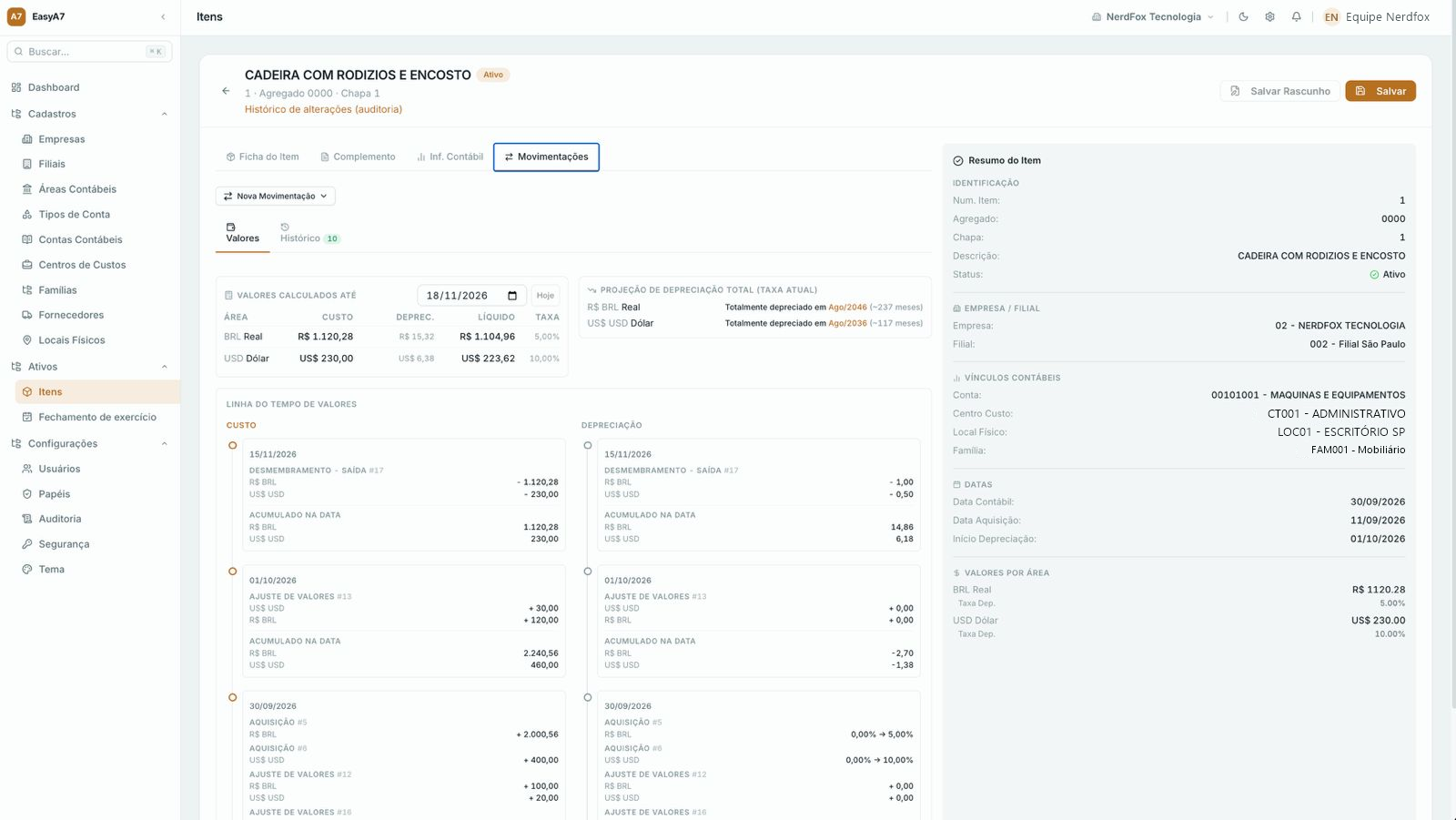
- Automatic depreciation calculation and a dashboard with the monthly evolution of cost, accumulated depreciation and net value, breakdown by accounting account and the fiscal year waterfall.
- Value on any date: cost, depreciation, net value and rate for each area, in reais and dollars.
- Projection: when each asset will be fully depreciated.
- Complete history: acquisitions, splits and value adjustments, with the effect of each movement on cost and depreciation.
- Linked to the inventory: receives the Easy AUDIT results to handle physical and accounting surplus items.
Inventory and depreciation, in the same cycle
Easy AUDIT and Easy A7 are linked: what the team finds in the field flows into reconciliation with the accounting register. Accounting surplus becomes a write-off analysis, physical surplus becomes an addition, and depreciation is calculated on what really exists.
See your fixed assets in Easy A7
We show the system with a demo base and assess the migration of your spreadsheet or ERP.
Informational content. References are CPC 27 (Property, Plant and Equipment), CPC 01 (Impairment of Assets) and IN RFB 1.700/2017.